

Frontier Culture Museum Spotlight: Mary Kate Claytor, Associate Director of Interpretation
October 12, 2026
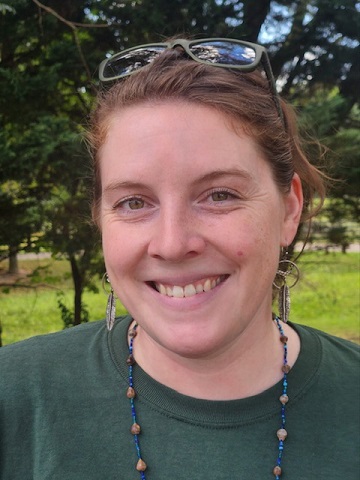
For Mary Kate Claytor, a career in historical interpretation began close to home.
Claytor, who grew up in Natural Bridge, Virginia, has always had an interest in history. Her first introduction to interpretation came through what she describes as her “first real job,” working as a tour guide at the Natural Bridge Caverns.
“My first real job was working at the Natural Bridge Caverns as a tour guide, when they were still open for tours,” Claytor recalled. “So that was kind of my first interpretation-type job, and my first job in general.”
Naturally shy, Claytor credits that experience with helping her develop the skills necessary to communicate effectively with visitors. Leading groups through the caverns required her to manage the practical responsibilities of a tour while finding ways to make history, geology, and ecology accessible and interesting to a wide range of people.
“Being able to have that job and sometimes have pretty large tours, taking them down into the caverns, making sure everybody was safe, and talking to them about the history and the geology and the ecology of the caves, I learned a lot,” she said. “And not just about the content, but how to work with people and how to get that information across in a way that is accessible and interesting.”
After three years at the caverns, Claytor moved into living history interpretation at the Monacan Indian site on the grounds of Natural Bridge. She had long been interested in Indigenous history and culture, and the position gave her an opportunity to explore that interest professionally.
It was also where she discovered how deeply she was drawn to living history.
“I think that’s really where I kind of caught the bug for interpretation because, for one, it was a huge learning experience for me,” Claytor said. “And not just the content but working with some of my colleagues who were Indigenous.”
That experience helped shape an area of interpretation that would continue to be important throughout her career: finding thoughtful, inclusive, and respectful ways to interpret Indigenous cultures while actively involving Indigenous voices in that process.
Claytor was also struck by the assumptions visitors sometimes brought with them.
“That’s one thing that I think struck me quite a bit when I was working at the village,” she said. “People have all these preconceived notions about what they think a Native person should look like.”
After completing her undergraduate studies with a minor in history, Claytor pursued graduate work at Virginia Tech in a museum studies program called Material Culture and Public Humanities.
“It was a brand-new program, and it gave me the opportunity to explore different interdisciplinary approaches to museum work,” she said. “I got to do everything from public history courses and oral history courses to exhibition design and display.”
By the time she completed graduate school, Claytor knew she wanted to continue working in living history and interpretation.
In 2015, that path brought her to the Frontier Culture Museum of Virginia.
She was initially hired as an interpreter, and her previous experience made the Museum’s Native American site a natural place to begin.
“When I first started working here, I spent most of my time at our Native site, just because that was the logical move considering that was already kind of my background,” she said.
Two years later, in 2017, Claytor became the Museum’s Associate Director of Interpretation, a role that expanded both her responsibilities and her familiarity with the many different stories, sites, and forms of interpretation represented throughout the Museum.
Interpretation Beyond the Exhibit
Claytor’s work at the Frontier Culture Museum eventually expanded beyond interpretive programming to include responsibility for the Museum’s livestock.
That role brought together several elements of living history, including agriculture, animal husbandry, and fiber arts interpretation across multiple Museum sites. It also led Claytor to learn a particularly hands-on historical skill: sheep shearing.
After several years at the Museum, longtime staff member Alex Tillen taught her the process.
“I worked with him and a couple of other interpreters, and I really enjoyed it,” Claytor said. “It’s a lot of hard work. It’s something that I find really rewarding, and I’ve always had an affinity for animals anyway. I’d never really been around sheep before working here, and I kind of fell in love with them, too.”
The Frontier Culture Museum’s livestock also provides another layer of historical context for visitors.
Under Claytor’s management, the Frontier Culture Museum has worked to maintain heritage breeds when practical and historically appropriate, including cattle, sheep, poultry, and some pigs.
“I think having those types of breeds to complement what we do on our farms gives a little bit more authenticity and more historical context for what some of these animals might have looked like during those time periods, or the different ways that people were using them,” she said.
Historical accuracy in livestock interpretation is not always straightforward, however.
Some breeds are extremely rare in the United States, while others may only be available overseas. There is also an important historical distinction between the animals people kept centuries ago and the formally defined breeds familiar to us today.
“Over the years, it’s been a little bit of a balancing act between finding livestock that are of a breed that we know would have existed during that time period, but also understanding that breeds, as we know them today, didn’t really exist in the seventeenth and eighteenth centuries,” Claytor explained. “It really wasn’t until the nineteenth century that you start seeing farmers taking extra care to selectively breed their animals for specific traits, which created differences in how those animals looked and how they could be utilized.”
That balance between historical evidence, practical realities, and meaningful interpretation is a recurring part of Claytor’s work.
Looking Ahead to the American Journey Gallery
As construction continues on the Frontier Culture Museum’s American Journey Gallery, Claytor is particularly interested in the possibilities the new indoor space will create for both interpretation and education.
She sees an opportunity to build stronger connections between the Gallery and the Museum’s outdoor sites, creating an even more cohesive experience for visitors.
For Claytor and her colleagues in the interpretation and education departments, one of the most significant benefits will be greater flexibility for year-round programming.
“We’re really excited in our interpretation and education departments about having those education rooms and spaces in the new building,” she said. “That would definitely allow us to have workshops or lectures and just give us so much more flexibility with engaging the public in ways that don’t necessarily have to be outside if the weather is bad.”
The new spaces will also make it possible to offer visitors additional materials, programs, and opportunities for engagement throughout the year.
“To have that flexibility, to bring people in and have materials that they can still engage with and information that they can collect, I think is going to be a game changer for us,” Claytor said.
A Creative Interpretive Team
For all of the history, research, skills, and resources involved in interpretation, Claytor says one of the qualities she admires most about the Frontier Culture Museum’s interpretive staff is their resourcefulness.
She describes them as having an extraordinary ability to “make something out of nothing.”
“It’s incredible,” she said. “If we have something that we may have limited information on, like a program that we need to do, or we need to pull something together at the last minute, even though that might not be ideal, I’ve seen miracles happen with our interpretive staff.”
That resourcefulness, she said, comes from a shared commitment to the visitor experience.
“They are very creative with solving problems,” Claytor said. “And I think at the end of the day, they are just really interested in making that connection with the folks who come to see us and wanting to make it a great experience. I really can’t say enough good things about our interpretive staff here.”
For Claytor, the future of living history at the Frontier Culture Museum lies in continuing to evolve the ways the Frontier Culture Museum connects people with the past while building upon the new opportunities emerging across the institution.
“I just think that living history here is something that I hope we can continue to evolve and build,” she said. “And I think that if we can keep doing that along with the new developments that we have here, we’ll have a very successful and exciting place for people to visit.”
After more than a decade at the Frontier Culture Museum, Claytor’s own career reflects much of that evolution. What began with leading cavern tours has grown into work spanning Indigenous history, museum studies, living history, livestock, fiber arts, staff leadership, and the development of new ways for visitors to engage with the Frontier Culture Museum.
Through it all, the central purpose has remained remarkably consistent: finding thoughtful, engaging ways to help people connect with the past.
About the Frontier Culture Museum of Virginia
The Frontier Culture Museum of Virginia in Staunton, is the largest open-air living history museum in the Shenandoah Valley and one of Virginia’s leading family and cultural tourism destinations.
Through historic buildings, demonstrations, exhibitions, and living history interpreters, the Frontier Culture Museum explores the cultures and traditions of Indigenous peoples of Virginia; German, English, and Irish immigrants who traveled through the Shenandoah Valley; enslaved Africans and their descendants; and the generations of people whose experiences contributed to the development of the region and the nation.
Visitors can also experience historic trades and aspects of daily life through demonstrations involving blacksmithing, woodworking, tailoring, spinning, foodways, agriculture, and other forms of work and craftsmanship.
The Frontier Culture Museum is currently undergoing its largest transformation in over 35 years with the addition of the American Journey Gallery.
For more information about the Frontier Culture Museum of Virginia, visit frontiermuseum.org
Free Initial Consultation - Let's Connect!

From graphic design for logos, brochures, and banners to robust website design & comprehensive marketing management, our team of graphic artists, website developers, digital advertising specialists, social media content creators, photographers, copywriters, and project managers work collaboratively with you to become your full-service marketing department!
Request Service
© 2026 Standout Arts, LLC. All Rights Reserved.
